
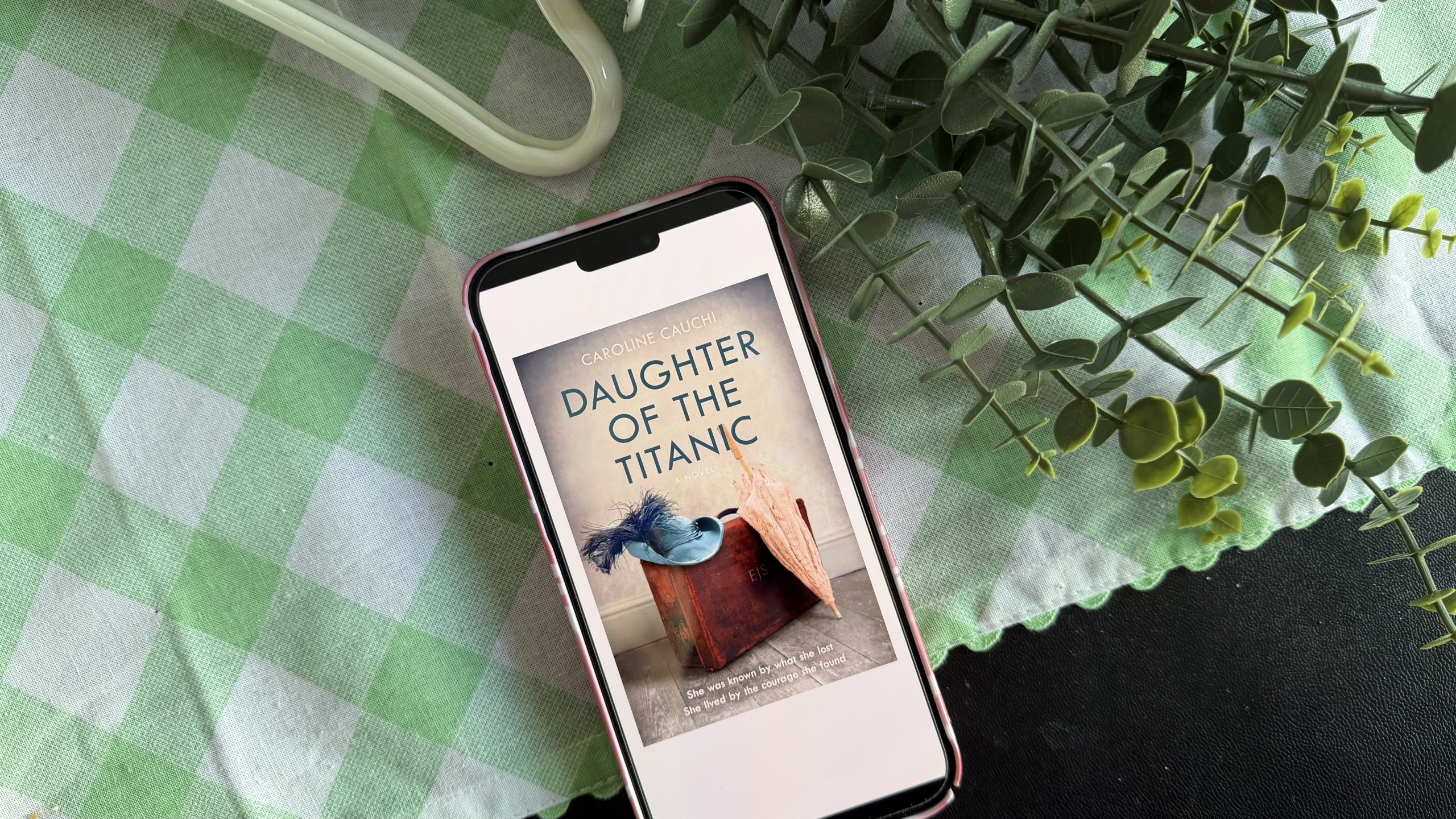
I love historical fiction and recently received a copy of the latest book by Caroline Cauchi, Daughter of the Titanic which is published this month. I’ve previously read Mrs Van Gogh, which I loved, so thought I would enjoy another book about a remarkable woman, Helen Melville Russell Cooke.
Daughter of the Titanic by Caroline Cauchi
She was known for what she lost
She lived by the courage she found
“Find Polaris”
When the SS Titanic set sail, Captain Edward John smith became a legend – and when tragedy struck he was a hero to some, reckless to others. But in the shadows of his infamy stood his daughter, left behind on the shore with nothing but whispers, rumours and the ache of unanswered questions.
For Helen Melville “Mel” Smith, Titanic was not just a shipwreck but a fracture that split her life in two. In every newspaper clipping, every account of that fateful night, Mel searched for the man she truly knew – the father who told her to find Polaris, the star that never moves.
Spanning the years after the disaster, this is the untold story of the girl history forgot – the daughter who carried the weight of a tragedy the world claimed as its own.
The blurb hooked me in straight away. My longstanding fascination with the Titanic – most recently rekindled during a visit to the Belfast Titanic museum – made this book especially compelling.
Back to the book. The story is told chronologically, framed via a series of interviews between Dr Catherine Haynes and Melville Russell Cooke. Dr Catherine Haynes, an Oxford art historian, examines Melville’s portrait as part of her research into how women are represented after catastrophe. She comes across a painting titled An Unlucky Woman, dated 1959, and believes it to be a painting of Melville Russell Cooke by David Rolt.
The book is sectioned into reels, following how Melville tells her story to Catherine. The titles follow the different roles she plays throughout her life: daughter, from 1912; guest of honour from 1914; wife, from 1921; a mother, from 1923; a widow, from 1931; a driver, from 1931; a muse, from 1936; a war mother, from 1943; a bride’s mother, from 1945; a recluse, from 1957; and a fortunate woman, from 1971.
The media repeatedly framed her life through the lens of tragedy, shaping a public image overshadowed by loss. As well as the interviews, Melville keeps a diary along with press clippings, relating to her father, Captain Edward Smith – as “proof that we existed beyond the tragedy”. She adds to this personal archive throughout her life and some of the press clippings appear in the novel.
Her first headmistress, Miss Bevan, tells young Melville that “if you cannot yet change how you feel, decide instead how you wish to be seen”. And this decision helps carry her through. From the tragedy of the death of her father; apparent suicide of her husband – an MI5 spy; the accidental death of her mother; and the death of both her children as young adults.
Melville was definitely a woman of her time. Privileged, rich, defined by who her parents were and who she married, as well as the society circles she moved in. Her position in society meant she played a part in her local community, from public speaking, to opening local events and fundraising. She was a public figure, art collector and campaigner, yet people decided her story without asking her.
She defied conventions of the time of a grieving widow. Paintings of women after the First and Second World Wars frequently show their sacrifice, devotion and serenity, and were often commissioned by official war artists, as Melville says “grief edited for public consumption”. However, the young academic Catherine Haynes calls the intimate portrait of Melville by Rolt as “undiminished” in direct contravention to this.
Because of her wealth Russell Cooke was able to enjoy hobbies which were unusual for the time, from car racing at Brooklands to flying. These activities were outside the normal possibilities for most women but I think this is what makes her such as interesting person to explore in Daughter of the Titanic. Multi-faceted, sharp, educated, charismatic and strong. Able to transcend what was happening to her and live her life, not hidden away or consumed by her grief.
Back to the painting of The Unlucky Woman and Catherine concludes that Melville was labelled as unlucky but they weren’t describing her but rather naming what frightened them, where her grief gets re-written as fate. The world had decided what she was, although she chose a different path.
I liked the ending of the book. Mel destroys the contents of the suitcase full of newspaper clippings and letters. The only thing she doesn’t destroy is the postcard from her father. After her death it sells for £10,000.
Daughter of the Titanic by Caroline Cauchi, published by HarperCollins 26th March 2026. Thank you to Netgalley for providing me with an ARC.